Sponsored content
For more than three decades, radiographers, technologists, radiologists and medical physicists around the world have learned MRI from MRI in Practice. The textbook usually ranks in the top 10 radiology books and is currently the number one best-seller in imaging systems engineering. The course has been presented by Dr Catherine Westbrook and Dr John Talbot since 1993, attracting over 12,000 participants and presented in 22 countries around the world.
In 2020, the course was completely redesigned from the ground up as an online offering. Our aim was not just to make it better than other online courses, but to make it even better than the live course. That is quite a bold claim, so we would like to take this opportunity to explain how the course works and what to expect.
The problem with live courses
Anyone who has attended a traditional conference or course will know the drill. You apply for study leave months in advance. Your department juggles the rota to cover your absence. You travel, pay for accommodation, and then sit through three or four intensive days in a crowded lecture hall, trying to absorb some of the most conceptually demanding physics in medical imaging at whatever pace the lecturer sets. If your attention drifts for ten minutes during an important topic, that material is gone. And when you get home, all you have left is your notes. MRI in Practice Online is designed to remove every one of these limitations.
Four days of learning, spread over nine
Our course contains the equivalent of four full days of teaching. Rather than compressing that into four intensive days, we spread it across nine.
It means participants can take the course without study leave. They can fit the lectures around their needs – before work, after work, on a day off, or in a quiet hour at the weekend. The department doesn't need to find cover. Participants don't need to spend money on travel or a hotel.
It also means better learning. Educational research consistently shows that spaced learning - studying material across several sessions with time to reflect in between - leads to deeper understanding and longer retention than cramming the same content into a single block. Participants come back to each new lecture having slept on the last one, and the connections start to form naturally.
Lectures on demand
There is no timetable to follow and no fixed start time to miss. You log in when you are ready, and you study at your own pace.
That matters enormously for a subject like MRI physics. You can pause a lecture to think a concept through, rewind a difficult explanation and hear it again, or stop to look something up in the textbook before carrying on. Nobody in a live audience can ask the lecturer to repeat the last five minutes three times over – online, you can do exactly that. Furthermore, our tracking systems keep you updated on anything you may have missed and ensure that all the content required for CPD certification has been completed.
Nor does access end the moment the course closes. All the revision material, animated diagrams, 10 free additional lectures and MRI simulator remain available, free of charge, for 12 months. Participants can return to them when they need a refresher, if they start working on a new scanner, preparing for an exam, or when a tricky clinical question sends them back to first principles.
See the physics move
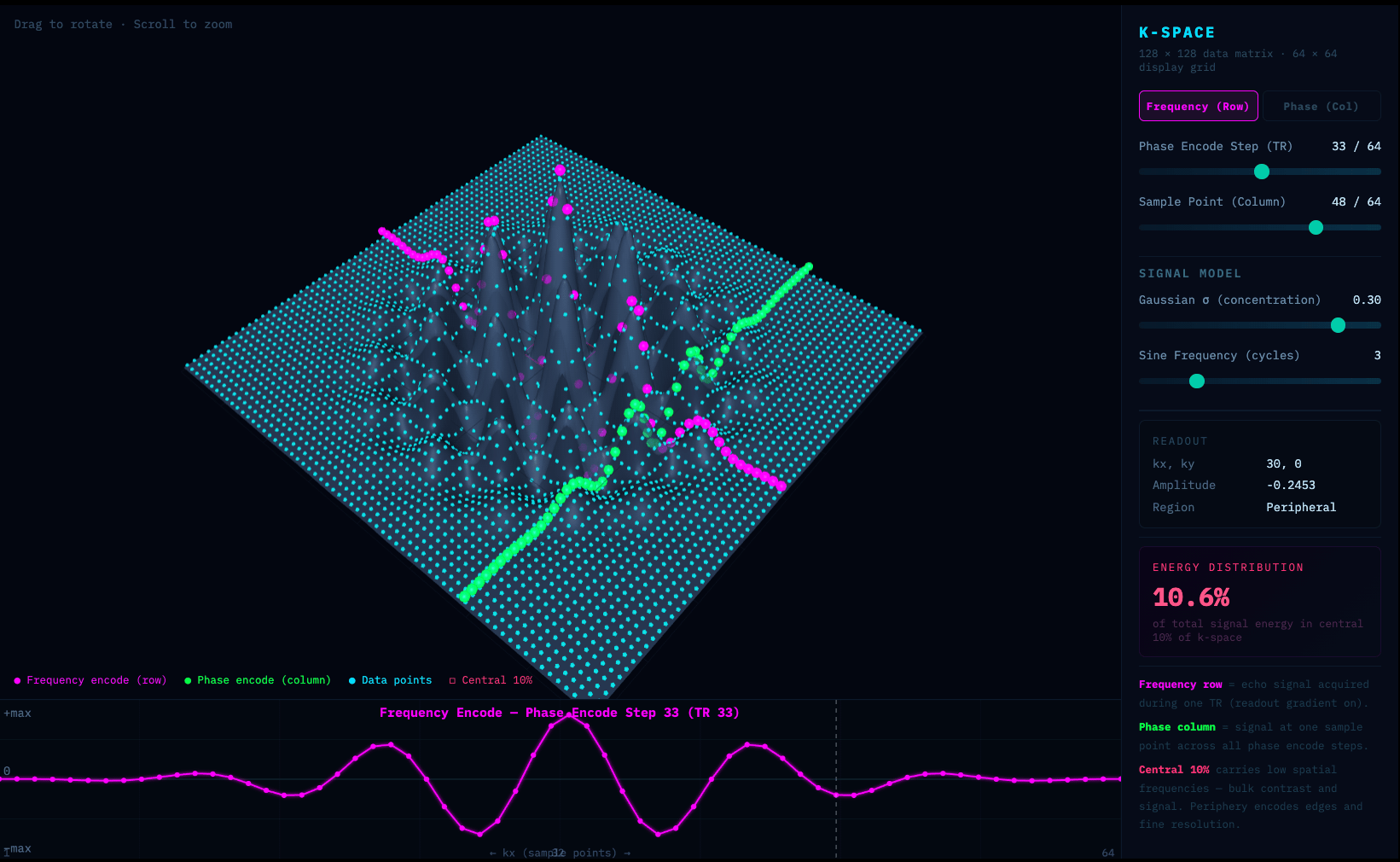
MRI is a dynamic subject. Protons precess, magnetisation tips and recovers, signals dephase and rephase, gradients switch on and off, and k-space fills line by line. Trying to understand all of that from static diagrams on a creaky old PowerPoint is hard work.
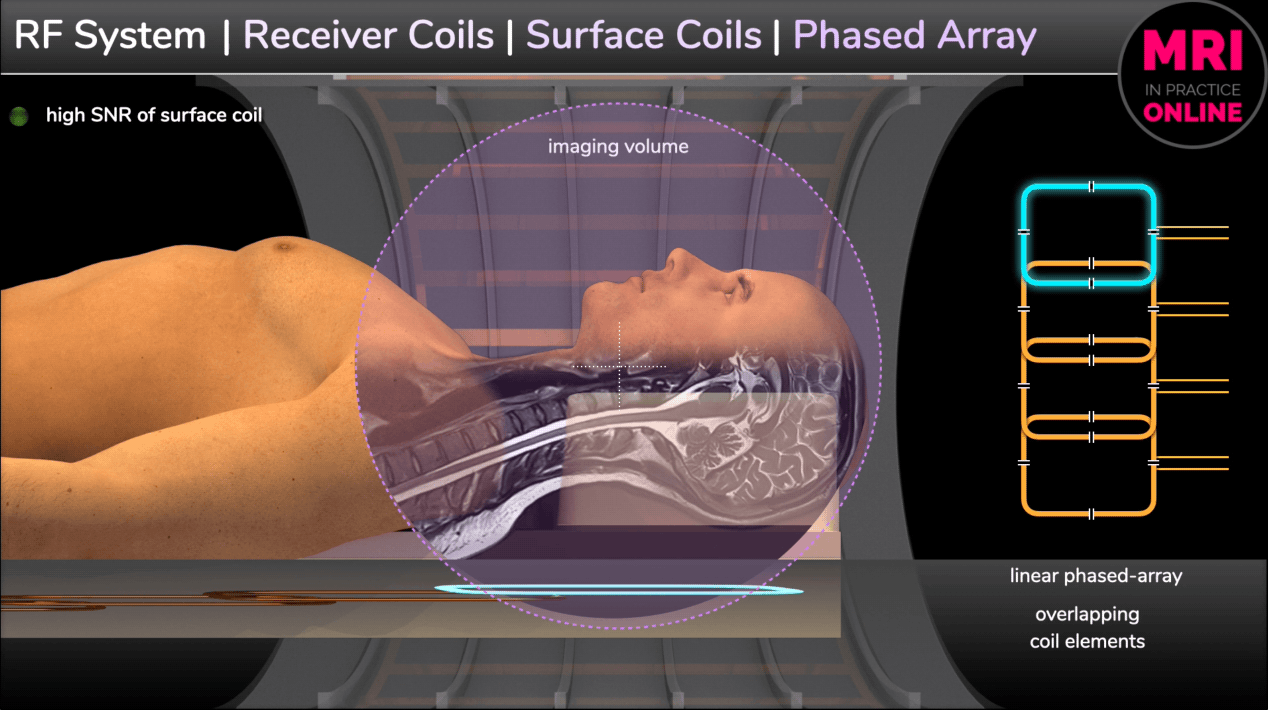
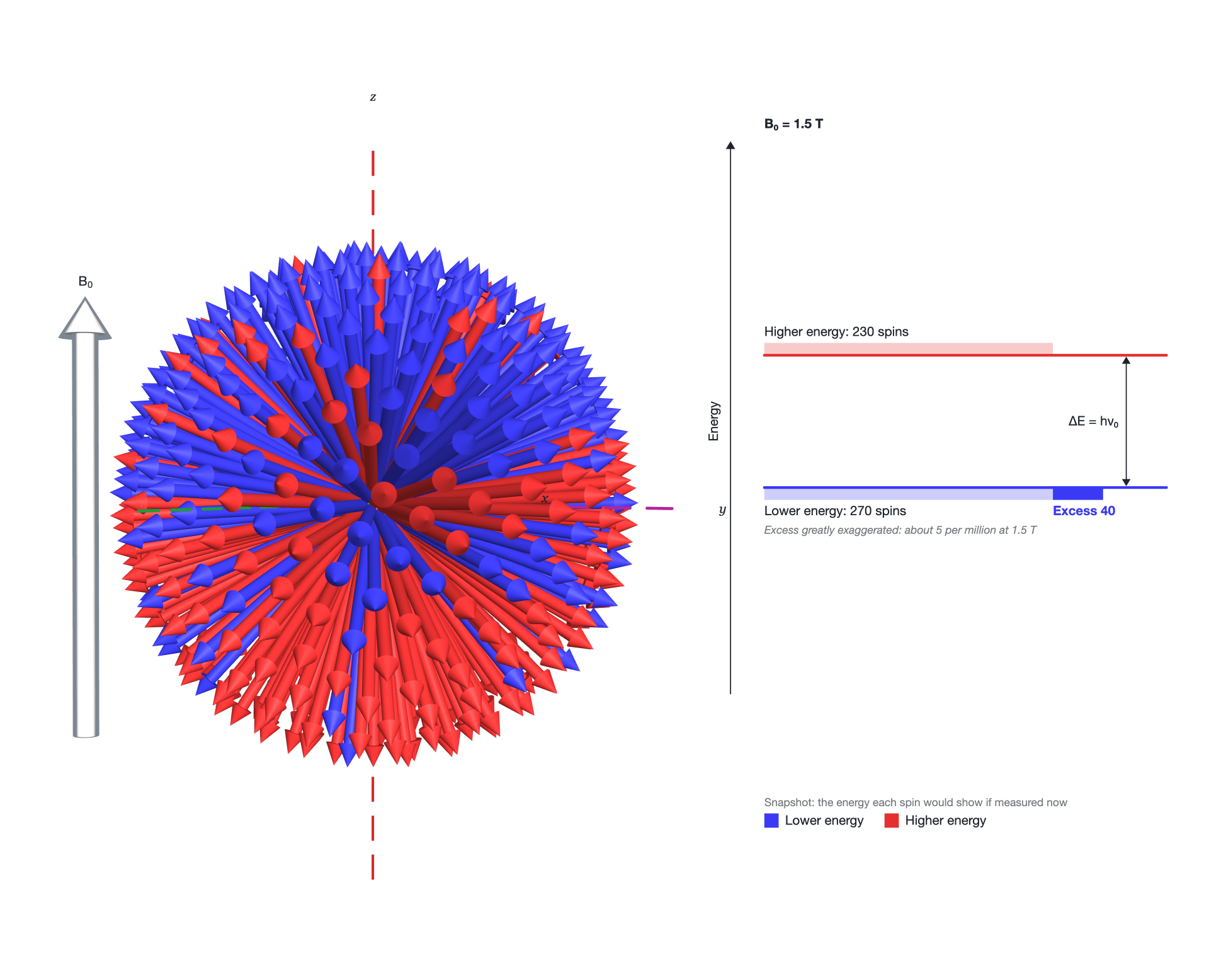
That is why animated graphics sit at the heart of MRI in Practice Online. Our lectures use purpose-built CGI animations to show you what is happening: the net magnetisation vector responding to an RF pulse, T1 recovery and T2 decay unfolding over time, spins losing and regaining phase coherence to form an echo, and gradients encoding position into the signal. Processes that take pages of text to describe become clear in seconds when you can watch them happen. Every model is built to illustrate the physics accurately, grounded in the primary literature rather than the AI slop, simplifications and misconceptions that circulate online. You don't just learn what happens – you see why. When the lectures are over, participants retain access to interactive versions of all the important animations for 12 months.
Hands-on with our MRI simulator
Understanding the theory is only half the story. The real test comes when you sit at the console and must decide what to change and why. On a live course, practical scanning experience is usually impossible.
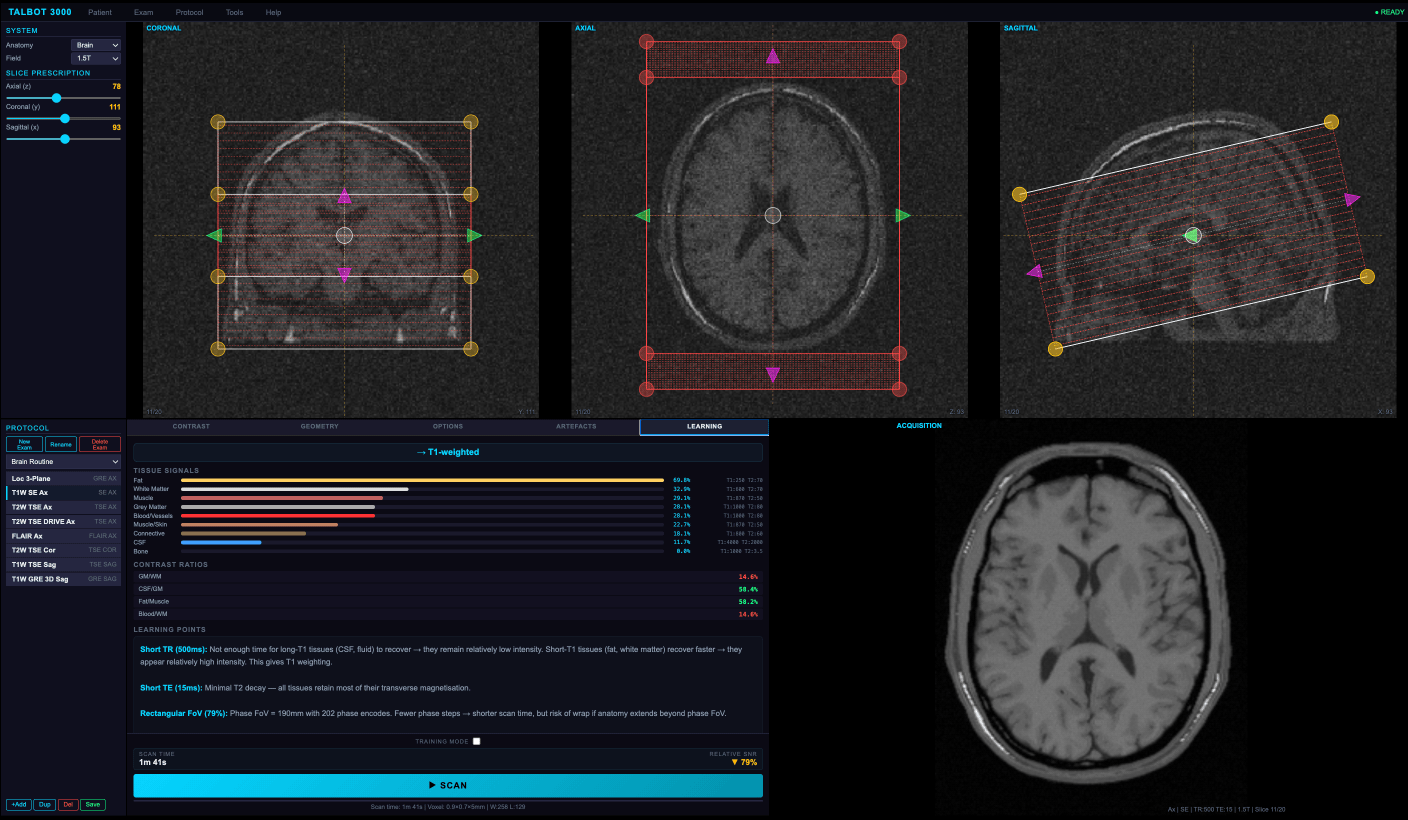
The simulator solves that. It is a realistic, browser-based simulator that lets you plan and run scans on virtual brain and abdomen phantoms, adjust parameters, and immediately see the effect on the image. It uses a genuine MRI signal processing path rather than faked images. All major artefacts are created for real. Change TR and watch T1 weighting appear or disappear. Alter TE and see T2 contrast develop. Add saturation regions, explore different sequences, and investigate the trade-offs between signal, resolution and scan time that every MRI practitioner needs to understand. Unlike any other MRI simulator, ours is directly linked to the lecture content, having a learning panel that tells the story behind every image you create.
You are never learning alone
A common worry about online learning is that it can feel isolating. We have designed MRI in Practice Online so that it is anything but.
The course chat room connects you with your fellow students and with the course team throughout the nine days. You can ask questions, share insights, compare notes on how things are done in your own department, and discuss the ideas that are giving you trouble. It brings together a community of MRI professionals from many countries and backgrounds, all working through the same material at the same time. In many ways this is richer than the interaction on a live course. Alongside the chat room, each core lecture has its own discussion space supported by Jeremy, our AI tutor, who is on hand around the clock to help you work through concepts from the lectures whenever a question occurs to you. Jeremy isn’t chat GPT, he’s our own chat bot - trained in-house by us and not connected to dodgy websites on the wider internet. It’s like having a friend who is an MRI expert on hand 24/7 – giving detailed, accurate, research-based answers when the course presenters may not be available due to time zone differences.
Online versus live: the honest comparison
Put the two side by side and the difference is clear.
- A live course requires study leave; ours doesn't.
- A live course means travel and accommodation costs; ours is taken from home.
- A live course crams four intense days into a fixed timetable; ours spreads the same learning across nine days, at your pace.
- A live lecture happens once; ours can be paused, rewound and revisited, with some material available for up to 12 months.
- A live course relies on PowerPoints and hand-waving; ours uses animated CGI graphics, HD video, and the very latest simulation software to show the physics in motion.
- A live course can't give you hands-on scanning practice; ours gives you the simulator free for 12 months.
- A live session ends when you walk out of the door; our chat room and tutor support keep the conversation going throughout.
Trusted, accredited and proven
MRI in Practice Online comes from the team behind MRI in Practice, the most widely used MRI textbook in the world, backed by more than 35 years of experience teaching MRI physics to radiologists, radiographers and our MSc students. We were teaching online decades before it became fashionable, and we have refined the course with every cohort. Compare that with other MRI courses where the faculty are seldom qualified in either MRI or education.
The course is endorsed through the Society of Radiographers' CPD Now scheme and accredited by ASMIRT, and on completion you receive a verifiable certificate recording your CPD hours – recognised evidence of your professional development.
Visit our website at www.mrieducation.com to discover more - or join our next cohort and discover why so many MRI professionals now choose to learn with us online.